Why You May Never Learn Another Language!

“Is it hard to learn another language?  Which is the easiest language to learn?  How long will it take to learn another language?”


These are questions I am constantly being asked by adults… adults who often regret the fact that they never mastered another language and, for that reason, are now motivated to give their children the opportunity to learn a second or a third language.

“I wish, I wish…. “ are most often the two words that come out of their mouths first.  And if you look at the questions that adults ask, they are all attached to an OUTCOME.  Most of us, as adults, like to know where we are going when we embark on a new journey.  “Where will it end?  Will I be successful?  What will the outcome be? Will I be any good?”

For adults who are thinking of learning another language, here is a great infographic on learning expectations for many languages, based on the amount of time it takes a native English speaker to achieve speaking and reading proficiency.

The Serendipity of Untranslatable Words

Being a speaker of several languages, I often find a foreign word popping into one of my sentences when I am speaking English. Those of you who speak another language may support me in the fact that, just sometimes, there is a so much more succinct way of expressing something in another language, where English can only resort to a string of words.  The problem is also that this ONE foreign word may also evoke a different emotional response, or transport the speaker back into another world, that the non-
An example contributed by our South African staff member today was the Afrikaans slang word “KNUIPING” which indicated the clenching of the buttocks when experiencing fear in order to avoid an untimely accident!  Well, that got us laughing and thinking…speaker will simply not understand.

Read more: The Serendipity of Untranslatable Words

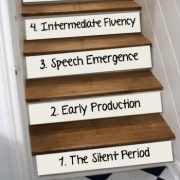
The 5 Stages of Second Language Acquisition

During childhood, the brain is more receptive to language learning than at any other time in a person’s life and starting foreign or second language learning early sets the stage for a child to develop advanced levels of proficiency in one or more languages. It is also increasingly being seen as a necessary 21st century skill set. Apart from the extensively researched and recognised cognitive benefits from learning one or more languages, doing so as a young child dramatically improves the development of a near-native pronunciation and language intonation.

More and more parents are accepting that knowledge of a language other than English (LOTE) can also enrich their child’s understanding and acceptance of other cultures, and the attendant future job opportunities it can bring in a world being brought ever closer together by increasing globalisation. So it’s no surprise that they are choosing to raise their child/ren as bilingual and/or give them the opportunity to learn a foreign language.

Read more: The 5 Stages of Second Language Acquisition

I Speak Dora

It is always refreshing to sit down on a mat with a group of enthusiastic pre-school children, their eyes wide, their minds open, ready to learn, ready to soak up new words and information, like little sponges.

I have been teaching languages to children, young and older people for about 25 years now.  Teaching languages to pre-school children remains my favourite age group, simply because they are “little language learning machines”, eager to pick up new ways to communicate in new worlds that they are creating every day.

About two weeks ago, in Auckland, New Zealand, I had the great pleasure of conducting a language lesson for pre-schooler children and found myself sitting in front of about thirty pre-school children with some of my Mandarin-speaking colleagues.  We were there to introduce a few French, Spanish, German and Chinese Mandarin songs and games to the kids.  We began by gauging our audience and asked how many already spoke another language at home.  The hands shot up and we were delighted by responses from a few bilingual Russian, Hindi, Arabic, Afrikaans, Korean and other Asian language-speaking children, keen to share greetings and expressions with us in their own native tongues.

Read more: I Speak Dora

Babelzone: Why LOTE teachers and Schools love our Language Learning Resource!

It is not easy to teach a second language and children can get easily bored with traditional teaching methods. This is what led LCF Clubs to create the global  interactive language learning website which is helping to revolutionise how children learn.  Read here about how it all began.

Babelzone is structured to suit all levels of language learning both in the LOTE classroom and at for children at home, who can use it as a place to have fun or as a learning tool to reinforce what they are learning in their Fun Language clubs. 

In the LOTE classroom, Babelzone links seamlessly with both Le Club Français and El Club Español, the LCF Curricula and there are additional supporting teacher resources and student workbooks. 

Ideal for use on Interactive Whiteboards or PCs, Babelzone engages by using catchy songs, games with an educational edge, stories to teach French or Spanish, MP3 files recorded by native speakers and printable activities to take anywhere.  Interactivity and structure are the keys to this fantastic online language learning resource!

Read more: Babelzone: Why LOTE teachers and Schools love our Language Learning Resource!

That Foreign Language May Not Be As Foreign As You Think. Or Might It?

Our ability to form a limitless number of thoughts into a spoken word is what distinguishes the human species from our less evolved cousins but, while we know that language first appeared among Homo sapiens around 30 000 to 100 000 years ago, we still don’t know all the secrets of exactly HOW language evolved, or how the thousands of languages we have today have developed.

When you hear somebody speaking Polish and another person speaking Persian, they sound like totally different languages, don’t they? But listen more closely and you’ll hear similarities, like how one of the Persian words for mother is mada, and in Polish, it’s matka.

That’s because both languages belong to a large family known as the Indo-European languages. A group that contains over 400 languages and dialects: Polish, Persian, English, French, German, Russian, Icelandic. The list goes on.

But if you trace all those languages to their roots, exactly where and when did they come from? It’s a 200-year-old question and a topic of controversy.

Read more: That Foreign Language May Not Be As Foreign As You Think. Or Might It?

Why Do Our Fun Languages Franchisees LOVE What They Do?

If you are looking for a flexible rewarding business, that works around you and your family, we would love to hear from you! ENQUIRE NOW. 
You can find out more about LCF Fun Languages franchise opportunitiesfranchise opportunities or DOWNLOAD AN INFORMATION PACK HERE

We’re so proud of our wonderful team of managers and language teachers – they are our greatest asset! So we’re doing a series of interviews to allow parents to get to know them better – who they are, how they came to be part of the Fun Languages family, why they do what they do and why they LOVE what they do!

Introducing Delphine Banse – Club Manager, Sydney(Central & North) 

“I always see the good side of things. This is why I have fantastic students, who make me feel awesome and show me that I am doing the best job in the world.” (Delphine – clown and eternal optimist!)

How did you end up in Australia?

I came to Australia in 2009 with my ex-partner Charly, who was born in France and raised in Australia. He was studying in Paris and when he finished his degree he thought it would be a good idea to go back to Australia. I didn’t want to let this handsome guy go on his own, so after I graduated, I followed him to Sydney. One week later, I started my new job in a design store, which is importing and selling French products. I was their perfect mascot and it gave me the opportunity to practice my English.

When did you first get involved with LCF Fun Languages?

That was pretty much just after I came to Australia. I met a French girl at a party, who was teaching French with LCF Fun Languages. She told me about LCF and how much she enjoyed teaching with them. I was really impressed by the concept and methodology and called the director of LCF Fun Languages, Nickie. We met for a coffee and I fell in love with Nickie’s character, her enthusiasm for the LCF methodology, her passion for languages and the amount of resources LCF is offering to teachers and franchisees. So, I decided to jump aboard and become a franchisee.

What do you love about it?

Well, I love teaching. There is a lot to love about being a teacher.


However, if you are a teacher at a normal primary or high school, students are obliged to come and learn. With LCF I feel like I have the best job ever: students, who are there, they really want to be there. They are motivated, enthusiastic, committed and we just have lots and lots of fun together. Teaching with LCF becomes very different to “ordinary” teaching at schools.

I also love the business side of it: Being a franchisee with LCF allows me to travel, meet new people, who are excited about learning and who are smiling all the time.

It is a fabulous job.

Ok, to be honest, I was a little bit sceptical about the admin part of running my own clubs, as admin is not one of my biggest strengths (laughs). I was surprised how easy it actually is. I take my time when I start a club. I prepare everything, get the material up to date and organise it in folders. Before a class I just pull out the folder I need and everything is already prepared and organised and I know exactly what we are going to do in class. If you are organised in the beginning, you will never struggle later on.

What is the difference to other teaching styles?

It is very flexible and totally different every week. It is so much fun – students and teachers are having a ball all the time. For example, just today we played a very active game called fruit salad, which was heaps of fun – for the students, for me, for everyone.

I am not the kind of teacher with a ruler in my hand. I am participating, I build relationships and I never need to do any discipline. My students know my voice, if I lower it they know something is going on and stop. It is a very stress-free environment. The kids can jump around, they don’t have to be stuck on their chairs. It is very opposite to an academic class – very easy and fun.
For the teachers it is very easy too. LCF offers a lot of content and each lesson is very well planned. They provide flashcards, board games, CDs, activity sheets, stickers and more, which makes it very convenient for teachers and lots of fun for students.

What was your biggest challenge when you started with LCF Fun Languages?

Well, building a portfolio is probably the biggest challenge. In the beginning I found it a bit hard to call schools, introduce us and make them listen to me. I wrote myself a speech and decided to go to the school and introduce myself and LCF in person. I found that it worked out much better when I was meeting the person responsible. I am a clown and love talk to people and make them laugh (laughs). I started with 1, then 2 and 3 clubs and all of a sudden I had 13. Parents, teachers and students spread the word. Word of mouth – this is what started my business.

Tell us one story about a child in your club who stands out with their ability or enthusiasm for language?

I have a 11 year old girl learning French with me for 5 years now and she is absolutely exceptional. She will understand almost everything and reply with simple sentences. She is a very academic learner and her goal is to do the IB (International Baccalaureate). Just a few weeks ago, she was interviewed by a famous Melbourne TV channel. They were interviewing children, who are passionate about languages and asked them to explain why and what they love about languages.

If you were asked which language was important to learn, what would you advise?

Mandarin. Just because I can’t speak it (laughs). It is a very good exercise for the brain. It is like math for me, and it is very big in the world. I love French, Spanish and Italian for their sound. I think every language is special.

Could you share one of your language teaching secrets with us?

I teach how to count and read numbers in ten minutes by drawing columns on a little table. My students learn the table and it is easy for them to remember, as they have to make their brain work. I also teach them the sounds first, so that they know how to pronounce the numbers.